The Evolution of Pokémon: From Game Boy to Pokémon Go
By Teddy Danielson · Edited edition:
Edited by The Nostalgic Millennial
Original publication and manuscript receipt dates are not established.

Choosing a starter, trading with a friend and trying to fill a Pokédex: Pokémon gave many millennials some memorable decisions to make. The games, cards and television series offered different ways into the same fictional world.
You might remember the version you played, the friend who had the other cartridge or the card you hoped to find. Revisiting the series can start with any of those memories.
Game Boy beginnings
Pokémon Red and Green launched in Japan in February 1996. Red and Blue followed in the United States in September 1998. The Pokémon Company's history distinguishes those releases; they did not arrive everywhere at once.
Creator Satoshi Tajiri's childhood insect collecting helped inspire the idea, as his 1999 TIME interview explains.
The first games introduced the Kanto region and the choice of Bulbasaur, Charmander or Squirtle. There were 151 original Pokémon to discover, though completing that collection involved more than catching everything in a single cartridge.
Trading and building a team
A Game Boy Link Cable let friends trade between their games. Version differences gave players a reason to compare collections and arrange a trade. The person with the other version could become part of how you played.
Type matchups and evolution also gave team-building some thought. Water's advantage over Fire was an early lesson; deciding which Pokémon to train or when to evolve one gave players more choices as they went along.
Television, movies and cards
Pokémon expanded beyond the handheld games. The television series began in Japan in April 1997, following Ash Ketchum and Pikachu, and the first film opened there in July 1998. Those dates precede their American releases.
Watching an episode or seeing Mewtwo on a cinema screen offered another way into the story. You could follow the characters without owning the same console as your friends.
Collecting the cards
The Pokémon Trading Card Game's US Base Set arrived in January 1999. Opening a pack and hoping for a particular card gave collectors a different experience from assembling a team in a game.
Some people learned the card game; others kept a binder of favorites or traded for the artwork they liked. A holographic Charizard could be a childhood wish without every collection having the same goal.
If you return to collecting, check the edition, condition and authenticity of an individual card. Pokémon's counterfeit-card guidance offers a starting point. A familiar character or an appealing listing photo does not establish what a seller will send.
New consoles, new adventures
Later games gave players new regions and features while keeping the familiar work of catching, training and choosing a team. These dates describe the original Japanese releases where a game arrived there first.
- Pokémon Ruby and Sapphire reached Game Boy Advance in 2002. Their Hoenn adventures introduced 135 new Pokémon and double battles, with two Pokémon on each side.
- Pokémon Diamond and Pearl arrived on Nintendo DS in 2006. Nintendo Wi-Fi Connection supported Internet trading and battles at the time; that historical feature is not a promise that the old online service works today.
- Pokémon: Let's Go, Pikachu! and Let's Go, Eevee! came to Nintendo Switch in 2018, before Sword and Shield.
- Pokémon Sword and Shield followed in 2019, introducing Galar and Dynamax battles. Pokémon's Galar tour brochure describes UK locations that inspired the games.
Returning to an older game can mean checking the hardware and its working features as well as remembering the adventure. A cartridge, an online service and a modern remake are separate things to compare.
From the Link Cable to Pokémon HOME
Pokémon HOME launched in February 2020 as a service for storing and moving Pokémon. Its Wonder Box and Pokédex features offer other ways to manage a collection, but movement between games has limits.
Check the official HOME transfer guidance for the Pokémon and destination you have in mind. Eligibility varies. In particular, a Pokémon sent from GO to HOME cannot return to GO.
Pokémon GO and playing outside
Pokémon GO launched in July 2016, bringing location-based encounters to phones. Parks, streets and familiar neighborhood routes became part of how people played. Camera-based augmented reality offered an optional way to view encounters; it was not required for every catch.
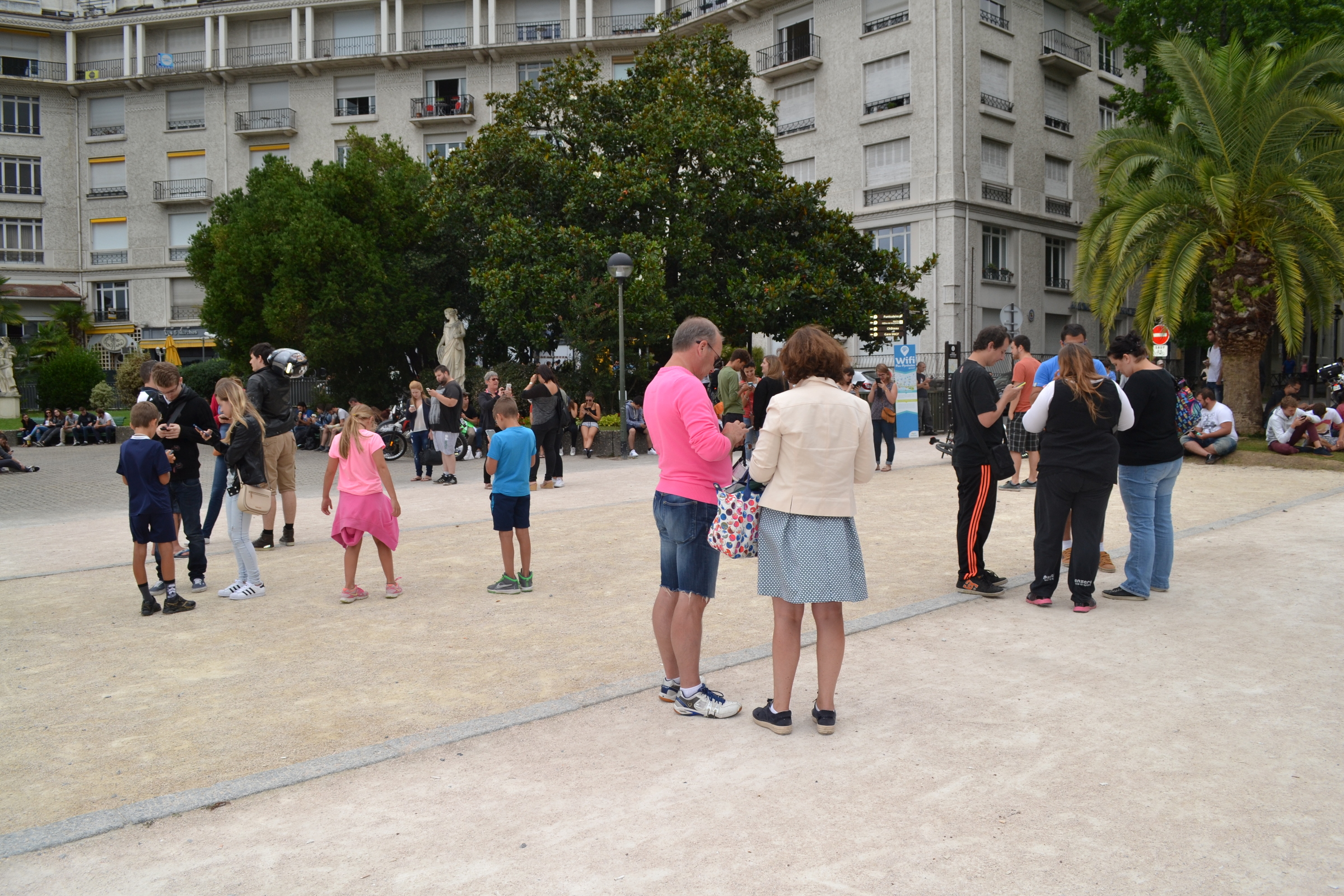
The gatherings in the photographs show people playing in London and Pau during that first summer. They document particular public events, rather than the experience of every player.
A changing game and community
Raids and community events gave players reasons to meet, compare catches and plan another visit. The game also changed after launch: friends and trading were announced in June 2018, and Trainer Battles followed that December.
The launch had server problems. Later updates added ways to play, but current features and events still need their own checks. Read the current GO news before making plans, and choose a place where you can pay attention to your surroundings.
What is officially announced next?
As of October 18, 2026, Pokémon Winds and Pokémon Waves are announced for a worldwide release in 2027, exclusively on Nintendo Switch 2. That is a release window, not an exact day or a promise that the games will work on the original Switch.
Follow official announcements for changes. A leaked plan or an AR/VR demonstration does not establish the features of a finished game you can buy.
What was your first Pokémon game?
Was it Red or Blue, a later handheld adventure or GO on a phone? You might remember the system, the starter you chose or the person who introduced you to it.
- Red, Blue or Yellow on Game Boy
- Gold, Silver or Crystal
- Ruby, Sapphire or Emerald on Game Boy Advance
- Diamond, Pearl or Platinum on Nintendo DS
- Sword or Shield on Nintendo Switch
- Pokémon GO on mobile
- Another game from the series
Revisiting a favorite with a friend can be as simple as comparing those choices. There is no need to have played every release to join that conversation.
Choosing a gift or a way to play
Paid links: we may earn a commission from qualifying purchases through the Amazon links below, at no extra cost to you. As an Amazon Associate I earn from qualifying purchases.
Start with the person's game, system and interests. Someone collecting older cards may want something quite different from someone choosing a Switch adventure or a phone accessory.
Vintage cards and original hardware
For a vintage card, compare the actual edition, condition and seller's evidence. Choose it for the collection you want to build; future resale value is uncertain.
For an original Game Boy and Red, Blue or Yellow cartridge, check that the hardware and game work, the cartridge is genuine and the seller explains condition and returns. Nintendo's information about older and used products provides context. It does not certify an individual marketplace listing.
Retro shops, auction sites and collector communities may offer different individual items. The precise console or card needs its own assessment; a generic product name cannot establish its condition.
Four individual Switch games
These choices are standard individual physical Nintendo Switch games. They are separate from digital codes, double packs, DLC bundles and hardware bundles. Check the selected seller's edition, condition and return terms before ordering.
- Pokémon Scarlet: view the individual US physical Scarlet game on Amazon (paid link).
- Pokémon Violet: view the individual US physical Violet game on Amazon (paid link).
- Pokémon Brilliant Diamond: view the individual physical Brilliant Diamond game on Amazon (paid link).
- Pokémon Shining Pearl: view the individual physical Shining Pearl game on Amazon (paid link).
Scarlet and Violet explore Paldea; Brilliant Diamond and Shining Pearl revisit Sinnoh. Choose the adventure the person wants and check Nintendo's current compatibility guidance for their console. These older titles are not described here as the latest releases.
Character merchandise
A plush, a shirt or something for the home depends on the recipient's favorite character and, for clothing, their size. The official Pokémon Center is a place to compare the actual items. Check the selected product and size rather than assuming every shop carries the same range.
GO Plus + and Poké Ball Plus are different
Pokémon GO Plus + connects with compatible smartphones for GO and Pokémon Sleep. In GO, it can spin PokéStops and automatically throw regular Poké Balls. Great Balls and Ultra Balls require button throws. It is not a controller for Let's Go on Switch.
This selection is Nintendo's GO Plus +, package model PMCAWNSAA. View the Nintendo PMCAWNSAA GO Plus + accessory on Amazon (paid link). Read the official GO Plus + instructions and current app/phone requirements before choosing it.
Poké Ball Plus is a different accessory. It can act as a controller for Let's Go, Pikachu!/Eevee! and connect with GO. Its stroll function with other supported games does not make it a controller for all of them. This listing is the standalone Nintendo accessory, model HACAPLSAA; a game and console are separate purchases.
View the Nintendo HACAPLSAA Poké Ball Plus accessory on Amazon (paid link). Check the offer's condition and included contents. The original Mew entitlement was redeemable once per device, so a used unit or factory reset does not guarantee an unused Mew gift. Pokémon's transfer support explains that limit.
Pick a starter, a version or a card you remember, and ask a friend which one they chose.